
SED 4: Relationships and Social Interactions with Peers
Return to DRDP Measure Video Examples
Definition: Child becomes increasingly competent and cooperative in interactions with peers and develops friendships with several peers
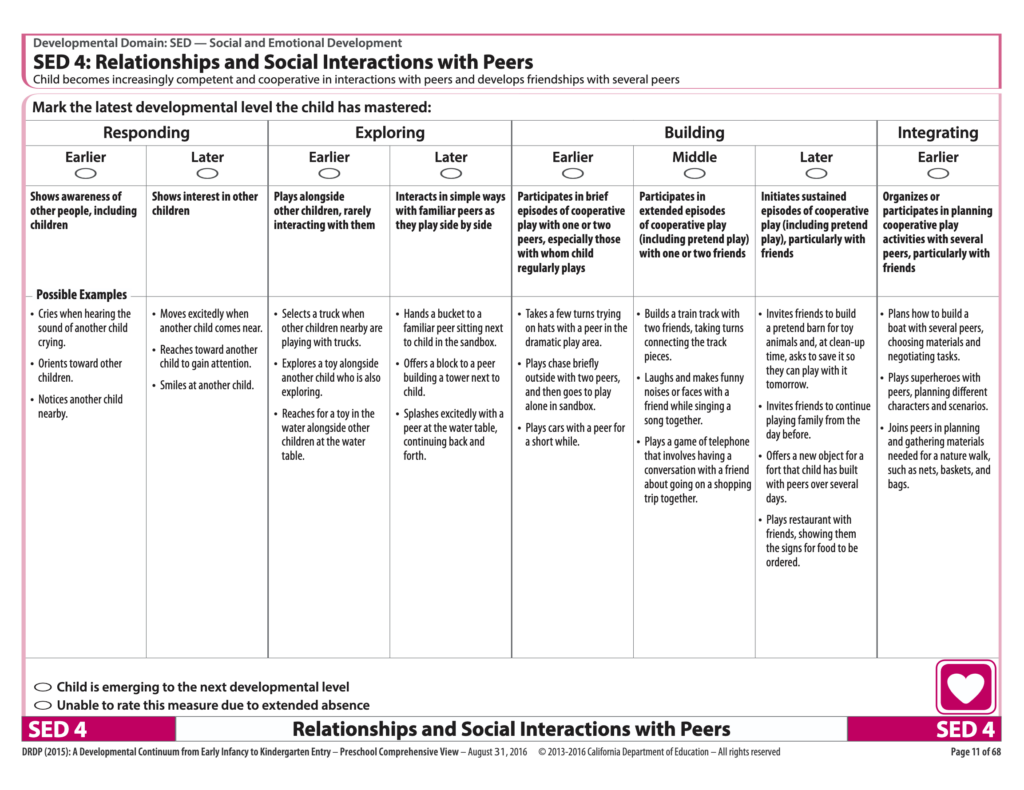
View examples of the developmental levels for SED Measure 4 below: Responding Earlier, Responding Later, Exploring Earlier, Exploring Later, Building Earlier, Building Middle, Building Later, Integrating Earlier
Responding Earlier
Shows awareness of other people, including children
Possible Examples
- Cries when hearing the sound of another child crying.
- Orients toward other children.
- Notices another child nearby.
Responding Later
Shows interest in other children
Possible Examples
- Moves excitedly when another child comes near.
- Reaches toward another child to gain attention.
- Smiles at another child.
Exploring Earlier
Plays alongside other children, rarely interacting with them
Possible Examples
- Selects a truck when other children nearby are playing with trucks.
- Explores a toy alongside another child who is also exploring.
- Reaches for a toy in the water alongside other children at the water table.
Exploring Later
Interacts in simple ways with familiar peers as they play side by side
Possible Examples
- Hands a bucket to a familiar peer sitting next to child in the sandbox.
- Offers a block to a peer building a tower next to child.
- Splashes excitedly with a peer at the water table, continuing back and forth.
Building Earlier
Participates in brief episodes of cooperative play with one or two peers, especially those with whom child regularly plays
Possible Examples
- Takes a few turns trying on hats with a peer in the dramatic play area.
- Plays chase briefly outside with two peers, and then goes to play alone in sandbox.
- Plays cars with a peer for a short while.
Source: California Department of Social Services. 2016.
Building Middle
Participates in extended episodes of cooperative play (including pretend play) with one or two friends
Possible Examples
- Builds a train track with two friends, taking turns connecting the track pieces.
- Laughs and makes funny noises or faces with a friend while singing a song together.
- Plays a game of telephone that involves having a conversation with a friend about going on a shopping trip together.
Source: California Department of Social Services. 2016.
Building Later
Initiates sustained episodes of cooperative play (including pretend play), particularly with friends
Possible Examples
- Invites friends to build a pretend barn for toy animals and, at clean-up time, asks to save it so they can play with it tomorrow.
- Invites friends to continue playing family from the day before.
- Offers a new object for a fort that child has built with peers over several days.
- Plays restaurant with friends, showing them the signs for food to be ordered.
Integrating Earlier
Organizes or participates in planning cooperative play activities with several peers, particularly with friends
Possible Examples
- Plans how to build a boat with several peers, choosing materials and negotiating tasks.
- Plays superheroes with peers, planning different characters and scenarios.
- Joins peers in planning and gathering materials needed for a nature walk, such as nets, baskets, and bags.